Traditional ERP and QMS systems store inspection results after the fact. They rarely show which lot is waiting for a decision right now, whether a hold actually stopped material from shipping, or how much the plant truly spends on scrap and rework.
ManuFactoryIQ connects incoming, in-process, and final inspections in one continuous digital workflow. Sampling plans, dimensional checks, shelf-life validation, MRB routing, retests, and final release stay synchronized with your ERP and warehouse inventory at the moment the decision is made.
Built around zero-defect manufacturing, continuous digital traceability, and closed-loop NCR disposition across mission-critical plants.
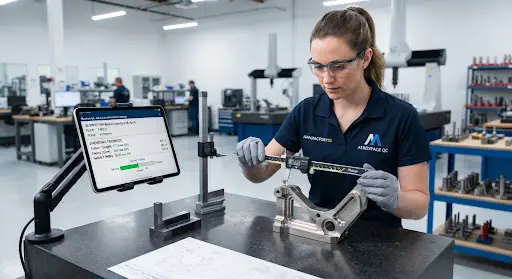
Inspection criteria that live in spreadsheets, printed traveler sheets, and individual operators’ habits drift apart over time. Two shifts inspect the same part differently, and nobody can prove which revision was actually applied.
ManuFactoryIQ manages inspection criteria, sampling rates, retest rules, routing sequences, and personnel alerts from a single auditable specification engine. Every manufactured part and incoming vendor lot automatically receives the exact checklist engineering defined for it.
Sampling rates respond to real performance. A supplier with a clean history moves to reduced inspection, while a lot family with recent rejections is tightened automatically until the evidence supports relaxing it again.
When a tolerance is revised or a drawing revision is released, collection plans update plant-wide across every connected tablet, CMM fixture, and optical scanner at once. No stale copies remain in circulation.
"One configurable source for inspection criteria, zero manual setup."
ISO, IATF, VDA, SAE International and FDA names and marks are the property of their respective owners and are shown to identify the audit frameworks the platform supports; they do not indicate certification or endorsement.
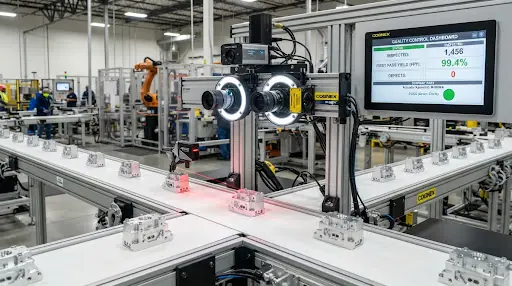
ERP systems report the yield that ships. They rarely report the offline touch-ups, repeated calibrations, and secondary machining runs that were needed to get there, so the numbers look healthy while margin quietly disappears.
ManuFactoryIQ measures first pass yield separately from final released yield and treats the gap between them as a measurable operating cost, not an accounting rounding difference.
Yield variation is analyzed in real time by product family, machining cell, tooling supplier, operator shift, or lot code. The same part number performing differently on two cells becomes visible within the same shift.
Every point on a yield chart links directly to the failed inspection records behind it, so a plant manager can move from a trend to the specific telemetry record in a single click.
"Reveal hidden factory rework and isolate the lines that generate scrap."
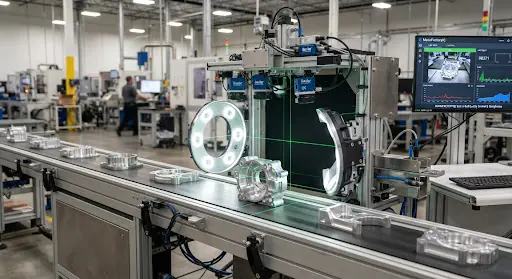
When a supplier issues a quality notification, the question is always the same: which finished goods contain that material, and where are they now? Reconstructing that answer from ERP reports and paper records takes days.
ManuFactoryIQ traces every serialized product and bulk lot through each manufacturing stage back to component batches, machine sensor files, and mill heat certificates — including the quantity consumed from each lot.
Inspection results, non-conformance records, torque logs, and digital sign-offs are attached to the same record, so the genealogy tree and the quality evidence are never two separate searches.
Backward and forward containment runs across raw stock, work-in-progress carriers, and finished goods pallets in seconds, and the resulting hold is written back to ERP inventory immediately.
"Instant backward and forward lot traceability in under five seconds."
Individual rejections look like isolated events on a shift report. The pattern only appears when defect codes are placed next to the machine, fixture, tooling, and shift that produced them.
ManuFactoryIQ clusters defect codes against machines, spindle telemetry, tooling fixtures, and shift patterns to surface recurring failure modes while they are still a handful of parts rather than a quarantined batch.
Micro-drifts in tooling vibration, thermal expansion, and feed rate are tracked continuously. These are the signals that no visual inspection catches and that only become obvious once parts are already out of tolerance.
Each detected pattern is delivered as a concrete recommendation with the affected equipment named, so containment can start before the statistical limits are breached.
"Predictive anomaly detection before parts drift out of tolerance."
A non-conformance closed on paper does not stop the material. Stock that was scrapped in a meeting can still be picked from its bin the next morning if the ERP balance was never touched.
ManuFactoryIQ guides every NCR through root cause, corrective action, preventive action, and verification before the case can be signed off, and structures the investigation with guided 5-Why and fishbone workflows.
The Material Review Board decision — scrap, rework, use-as-is, or deviation — is executed directly against physical warehouse locations and ERP inventory balances at the same moment.
Nothing depends on someone remembering to post a movement afterwards. The disposition, the stock transfer, and the audit record are one transaction with an electronic signature attached.
"Structured 8D and 5-Why workflows with instant physical inventory interlock."
Most audit effort is not spent proving compliance. It is spent finding the calibration certificate, the signed inspection sheet, and the deviation approval that were filed in three different places.
ManuFactoryIQ maintains continuous compliance dossiers for ISO 9001, ISO 14001, IATF 16949, VDA 6.3, AS9100D, and FDA 21 CFR Part 11 as a by-product of daily inspection work rather than a pre-audit project.
Every summary drills down to the underlying calibration certificates, machine inspections, electronic signatures, and tamper-evident event histories behind it.
When auditors arrive, the dossier is generated on demand in the structure lead auditors expect, with the complete record chain intact.
"Pass audits with zero document hunting and a complete record chain."
 ISO 9001
ISO 14001
 IATF 16949
 VDA 6.3
 AS9100D
 21 CFR Part 11
Quality departments are asked to justify their budget with defect counts, while finance measures the plant in dollars. The two conversations rarely use the same units.
ManuFactoryIQ connects scrap write-offs, rework operator hours, lab testing fees, and customer RMA allowances to financial values, reporting the cost of poor quality both as absolute spend and as a percentage of net sales.
Internal failure, external failure, appraisal, and prevention costs are separated, so investment decisions are made against the category that is actually driving the loss.
Plant directors and continuous improvement managers drill from a monthly chart straight to the shop-floor transactions, tooling, and part numbers behind an unexpected variance.
"Turn quality into a measurable profit driver, not an overhead center."
ManuFactoryIQ bridges SAP S/4HANA, Microsoft Dynamics 365, Oracle Cloud, and NetSuite with shop-floor CMMs and gauges through bidirectional synchronization — without replacing the systems your finance team already trusts.


See how ManuFactoryIQ layers over your ERP to run real-time inspections, automate CAPA workflows, and guarantee complete lot genealogy.